
The Hidden Winter Pest Danger: Why Rodent Mites Invade Your Home After Rodent Extermination
When Mice and Rats Die, the Real Nightmare Begins: The Untold Truth About Post-Extermination Rodent Mites Why do you get mystery

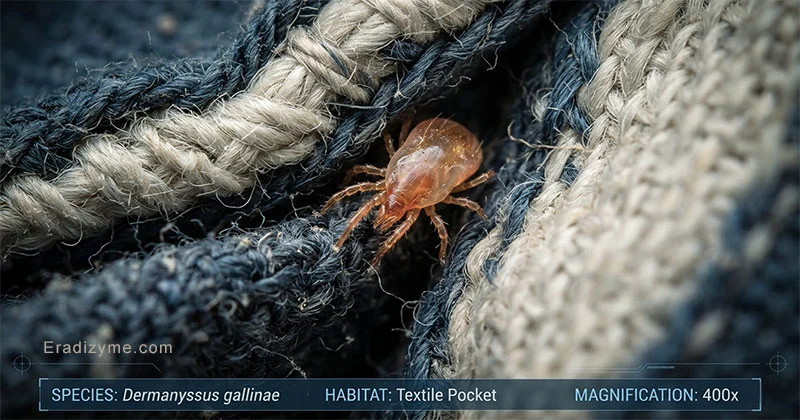
Why do you still feel crawling and biting sensations after treatment?
Post-treatment sensations typically stem from two causes: active survivors hiding in structural voids, or a histamine storm from residual proteins triggering hyper-reactive nerve endings.
You did the hard work. You located the abandoned bird nests in the eaves or, cleared the rodent entry points in the attic. You treated your living spaces, deep cleaned the perimeters, and washed your bedding, using standard deep-cleaning cycles. Yet, the moment you sit down or climb into bed, you still feel that unmistakable, maddening crawling or biting sensation on your skin.
If you have been dealing with a persistent mite infestation for months after the original host source was eliminated, this information is specifically for you. At Eradizyme.com / Beyondbeds we have spent years helping people handle both bird and rodent mite infestations. Our phones ring daily with calls from people who are completely stuck, which means we naturally get to hear about all the cases that conventional methods fail to resolve.
We are not suggesting that professional pest control methods don’t work, or that people never find success with standard procedures. We simply do not hear from those people. We only hear from the hundreds of individuals who have tried standard methods with absolutely no success. Based on their collective data, the reality of these infestations conflicts sharply with standard internet consensus.

When dealing with a stressful infestation, it is natural to search the internet for quick answers. In a recent Reddit thread, a panicked user reached out to the community for help after discovering bird mites. A well-meaning commenter responded with a common forum consensus: “Do not panic. Once the nest is removed, the mites cannot live or reproduce without the original host and will simply die off.”
While that specific poster was fortunate enough to encounter bird mites only on the outside of their home and stem it off by having a professional exterminator spraying the exterior, this advice is dangerously misleading for indoor infestations.
Internet commenters are often quick to give advice based on limited encounters, or on information they simply looked up and read from available online data. When a user comes across the idea that bird mites or rodent mites cannot survive or reproduce indoors without their original hosts, it puts them in a dangerous position. They let their guard down, failing to do everything necessary to stop these parasites from multiplying indoors.
If you are one of these people living with bird mites for many months after the original host is gone, then you know that in your reality this is not true. If you are one that just encountered a bird or rodent mite infestation and after having searched the internet, you stumbled upon posts like the Reddit post highlighted in this article, our advice is to stop and think. Do not grasp onto what you perceive as the easiest fix. It may cost you unnecessary time and money. Know this, for most people who have been dealing with these parasites for months, there is no quick way to rid an indoor bird mite or rodent mite infestation.
To elaborate and drive this point home, let’s look at what could actually happen when these pests invade human spaces. We have spoken directly to customers who had nothing more than a single bird nest outside on a windowsill. That one bird’s nest seemed to be the smoking gun, meaning that lone nest turned out to be the absolute source of their bird mite infestation.
The indoor infestation persisted furiously for months. These people even contracted with professional exterminators who would come to their home every week to ten days to spray, yet they never felt the relief. Out of sheer exhaustion, these families finally decided to pack up everything and move away to start over. Yet, within just a few days of arriving at their brand new home, they started experiencing the exact same mite problems they thought they had left behind.
In some cases, we hear from heartbroken people who have moved three separate times trying to flee the infestation. The reason this must be discussed is that most available internet data claims bird or rodent mites cannot live or reproduce on human blood, insisting they only survive on avian or animal blood. Ask yourself that question: what are these mites surviving on if the original bird source has been absent for months or even years?
This data is not a theory. It comes directly from the real people we work with every single day. This article is written for those who have discovered firsthand that the popular internet “original host source” idea is simply not based in reality.
Eradicating an indoor bird mite or rodent mite infestation is fundamentally a numbers game. It is not a one and done process. It takes time due to two distinct biological realities.
First, these pests are deep hiders. For an in depth understanding of how these parasites exploit your home’s architecture, we highly encourage you to read our detailed reference article: “How to Find Bird and Rodent Mite Nests in Your House” (eradizyme.com).
As outlined in that article, these pests do not sit out in the open. They retreat into microscopic structural voids behind baseboards, inside electrical outlets, deep within mattress seams, up inside box springs, and inside attic insulation panels. When you pack up to move, they hitchhike deep inside your furniture, clothing, and electronics.
If you have been treating your environment aggressively and still feel crawling, your situation typically falls into one of two distinct scenarios.
The first scenario is a post mite histamine storm, which causes severe nerve trauma. Bird and rodent mites are aggressive blood feeders. When they bite, they inject an irritating, highly potent saliva into your skin to keep your blood from clotting.
Even after Eradizyme breaks down and kills active mites, residual salivary proteins and microscopic mite debris remain deeply embedded in your home and your skin pores. Your immune system views these left-behind foreign proteins as active, ongoing threats.
In response, your mast cells continuously flood your skin tissue with histamines. This local chemical overload triggers intense itching, sudden prickling, and crawling sensations, which is known medically as formication, the perception of insects crawling on or under the skin. This physical nerve trauma should never be confused with delusional parasitosis.
Your nerve pathways are not creating a psychological delusion; they are responding to a real, lingering chemical reaction under the skin. Think of your skin’s nerve endings like a home security alarm that has been triggered repeatedly for weeks. Even after the intruder is gone, the internal electrical system stays tripped, hyper-reactive, and ringing.
The histamine overload keeps the nerves inflamed and firing off false signals. Because of this neural damage, your nerves mistake a completely harmless touch, like a tiny air current from a ceiling fan or a shifting clothing fiber, for an active, crawling parasite. The sensation feels entirely real because your nerve pathways are physically broadcasting a real alarm signal to your brain.
The second scenario involves surviving hidden pockets. Because these parasites are deep hiders, your initial treatments may have eliminated most of the population, but a tiny percentage may still be actively hiding, hitchhiking, and attempting to feed in your structural sanctuaries.
Distinguishing between a lingering allergic reaction and a failed treatment is crucial to protecting your sanity and stopping the cycle of over spraying your home. With an active infestation, you will see visible, fresh, bright red, highly itchy punctures appearing daily.
The post mite immune response brings intense itching or crawling sensations without any new physical marks. Active sensations peak rigidly at night when these vector mites are most active. An immune response flares up randomly, especially when your body temperature rises, such as during warm showers. Active bites are highly concentrated on targeted areas like the waistline, chest, or inner arms, while immune driven prickling consists of general, moving sensations that rapidly skip across the entire body.
When you are completely exhausted and searching for answers, the last thing you need is a sales pitch wrapped in an article. This guide is written to offer an in-depth look at what actually happens when treatment stalls. We are not providing this information as a transactional sales pitch to sell you a product. Obviously, we are partial to our product for this use, and it is clear that we do make an effective, highly concentrated enzyme product that works very well for this purpose.
However, this piece is about exposing the raw reality of these infestations based on hundreds of real-world accounts. We are committed to speed people through their learning curve by simply providing the contrasting truth of this unfortunate reality. You cannot just spray once and stop. You must systematically chip away at their numbers until the population is completely zeroed out.
Step 1: Dismantle Environmental Allergens and Stray Mites. Standard laundry detergents completely fail to remove sticky parasite proteins. Use 1 to 1.5 ounces of Eradizyme Ultra Concentrated Enzyme Formula per load. Its natural enzymes physically digest and dissolve both the live pests and the protein-based allergen debris via enzymatic hydrolysis.
Step 2: Maintain a Perimeter Defense. To keep this article focused on diagnosing why crawling sensations persist, we have detailed our technical spraying and vacuuming routines in separate strategic guides found throughout our website and the Eradizyme Knowledge Hub. You can also call us directly to discuss your specific layout. Consistently treating physical entry points is exactly how you stop hidden survivors from multiplying and win the numbers game.
Step 3: Calm Your Nervous System. If your symptoms line up with a post-mite immune response, speak with a healthcare professional about utilizing targeted antihistamines and natural anti-inflammatory choices, to quiet your body’s hyperactive nerve pathways. For targeted epidermal relief, look for topically applied natural mast cell stabilizers. Chamomile contain
Figuring out the line between a lingering immune response and a stubborn, hidden bird or rodent mite pocket is physically and mentally exhausting. Do not let overly simplistic forum advice delay your response or dictate your eradication strategy.
Reach out directly to the resident expert at Eradizyme.com by calling 888–774–4046. We are available seven days a week from 9:00 AM to 11:00 PM EST. Get a free, zero obligation consultation based on real world data to help you win the numbers game and reclaim your peace of mind.
The Eradizyme Head Researcher specializes in structural parasite biology and environmental decontamination protocols. With years of dedicated field experience and real-world data collection, their work focuses on analyzing the domestic survival mechanics of bird and rodent mites to help individuals successfully eliminate persistent indoor infestations.


When Mice and Rats Die, the Real Nightmare Begins: The Untold Truth About Post-Extermination Rodent Mites Why do you get mystery
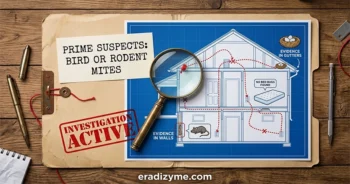
How to gather evidence and prove that hidden bird mites or rodent mites are invading your home Where do bird and