Can You Have a Bird Mite Infestation Without an Active Nest on Your Property?
The clinical clock is the first enemy of anyone dealing with an environmental parasite. In most medical practices, a doctor has less than twenty minutes to listen, assess, and write a prescription. When an 80 year old woman walks in describing a distinct crawling sensation, tiny, invisible pinpricks stinging her skin, and a sense of crawling in her nose, ears, head, and scalp, that clock immediately works against her.
What follows is a familiar pattern of medical guessing games.
One doctor glances at her skin and dismisses the agonizing torment as simple, age-related dry skin. Another doctor jumps to the conclusion of a scabies infection. Yet, the diagnostic math does not add up. There is no classic scabies rash between her fingers or toes.
She lives alone, and has had no close physical contact with anyone who could pass on a human-to-human parasite. No skin scraping is performed to confirm the presence of mites under her skin. Even when an eye examination detects physical mites on her eyelashes or eyelids, there is no identification of the species.
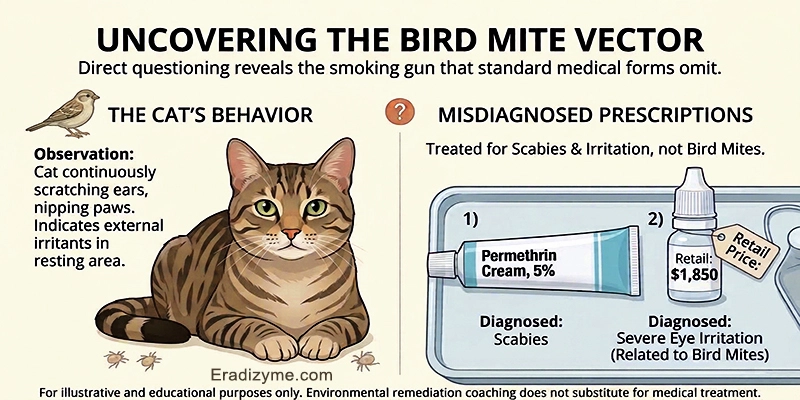
Clinics routinely look right past the reality that Demodex mites are a normal, universal part of the human skin microbiome, with virtually 100% of adults over the age of 70 or 80 hosting them on their skin and eyelashes. Instead, she is handed a prescription for toxic Permethrin cream and a prescription for expensive eye drops.
She did not remember the name of the eye drops, other than saying they were very expensive, and she could not afford them. Based on standard clinic patterns, the doctor most likely assumed a Demodex mite issue and prescribed an ultra-expensive antiparasitic eye drop like Xdemvy, which can retail for nearly $1,850 a bottle. She is sent home to an unchanged environment, completely bypassing the physical source of the crawling.
The fundamental flaw in this clinical approach is a total failure to look beyond the human body. A doctor’s office is designed to treat the patient, but when dealing with ectoparasites, the patient’s home is the actual source of the crisis.

Dissecting the Repellent Trap of Chemical Creams
Treating an environmental mite infestation with a localized body cream like Permethrin, creates a temporary, frustrating cycle, because it relies on a complete misunderstanding of how non-burrowing bird mites or rodent mites operate.
Permethrin cream turns the human skin into a toxic environment for a short window of time. For the hours that the cream is active, it does not eradicate the infestation; it merely acts as a temporary deterrent on the skin. As I often explain to my customers:
“Applying a toxic chemical cream to your own body while the main Breeding ground of mites remains completely untouched in your living space is like spraying yourself with bee killer rather than spraying the hive.” — Head Researcher, Eradizyme.com
Bird mites and other blood-feeding mites typically do not live, breed, and multiply on human skin tissue. While mainstream science does not document this as typical behavior, and doctors often use that textbook rule to dismiss a patient, Eradizyme’s real case reports tell a different story. There have been documented instances where these pests appear to be living directly in a person’s hair, scalp, and skin. Although rare, this situation has certainly not been disproven. More commonly, they live in the structural voids of the home, the furniture, the carpeting, and the bed.
The moment the chemical cream washes off or wears out, the human body is no longer toxic to the pest. Because the actual breeding ground of mites living in the surrounding rooms remains completely untouched, they simply migrate back to the chosen host to feed again.
These parasites are highly selective, meaning they will intentionally target one specific person while completely sparing others living in the exact same household. You can dive deep into the biological data behind this targeting behavior inside the Eradizyme Mite Magnet™ Article, which details how someones sweat chemistry, body heat, and immune profiles transform specific people into a Mite Magnet™ while others are left completely untouched. This selective tracking leaves the chosen host isolated in their suffering, while the hidden environmental hotbed continues to thrive.
Beyond its failure to clear the infestation, pushing this Permethrin cream protocol onto an isolated elderly patient without asking the right questions is reckless on the part of the doctor and carries serious safety risks. Massaging this strong chemical into thinning skin can cause painful irritation, while mild systemic absorption of Permethrin during the mandatory twelve-hour exposure window can induce dizziness, creating a dangerous fall risk for an elderly person living alone.
t should be a doctor’s core responsibility to ask these deep environmental questions and heed these serious warnings, rather than just haphazardly prescribing a toxic cream without stating the inherent risks, especially for elderly patients. Failing to do so can have devastating consequences at home, which is exactly why a doctor must always ask if the patient owns a cat before prescribing this medication. Permethrin poses an immediate, deadly threat to an indoor cat.
Permethrin is highly toxic to cats because their livers lack the specific enzymes required to metabolize it. If the cat rubs against Permethrin-treated skin or rests on contaminated bedding before it is laundered, the exposure can trigger neurological tremors and seizures that can easily be fatal to cats. As an absolute rule, you must also never spray over-the-counter Permethrin mite killers, flea foggers, or household bug sprays inside your home if you have cats, as environmental residue on floors and carpets is just as deadly to their nervous systems
You can review the primary toxicological data information directly via the International Cat Care Permethrin Poisoning Guide, which details how secondary chemical exposure triggers central nervous system issues in cats.
Understanding the Wildlife Entry Point
Based on data online, many people assume a bird mite infestation requires an active nesting site on the property, but a home does not need a physical bird’s nest to be hit with an ongoing infestation. This narrow assumption causes both doctors and traditional exterminators to overlook the true source of an indoor crisis.
Can a pet cat bring bird or rodent mites into a clean home without an active bird nesting site or a rodent infestation on or in the house?
Yes. A common entry point occurs when an indoor cat hunts a wild bird or mouse and brings the carcass inside the home.
The moment a bird or rodent dies, its body heat drops rapidly, forcing blood-feeding mites to abandon the host in search of a new, warm body. They transfer to the cat, hitchhike into the living space, and quickly scatter into carpets, upholstered furniture, and baseboards.
While mainstream entomology data insists that these mites cannot successfully reproduce on human blood and will shortly die off without an animal host, our years of speaking directly to hundreds of sufferers have thoroughly debunked this textbook myth.
We have documented numerous situations where the original host source was completely removed, yet people remained severely affected for many months. Some people have relocated entirely, only to bring the mites along with them in their personal belongings, extending the cycle of environmental trauma for years after fleeing the original affected property.
You can read the full breakdown of these multi-month struggles inside the Eradizyme Knowledge Hub Article on Mite Realities, which documents the real, lived experiences of sufferers who have dealt with these persistent environmental hitchhikers long after the original birds were gone. They will relentlessly bite, crawl, and sting humans out of desperation, creating an environmental issue that a Permethrin cream cannot solve.
Case Analysis: Tracking the Source Through Direct Consultation
When this woman reached out to me, she had just returned from a twenty-minute doctor visit with zero answers. To uncover the true nature of her infestation, I initiated a systematic evaluation, asking the environmental and lifestyle questions that doctors and standard medical forms completely omit.
First, I asked her if she had noticed any physical evidence of the pests in her home, specifically if she had seen any tiny, pepper-speck-sized dots moving on her bed or furniture. She confirmed that she had. Next, I asked about the structural layout of her property to check for active wildlife nesting sites, specifically if she had any nesting birds on the roof, under the eaves, or anywhere around the immediate exterior of the house. She answered no.
Since there was no active nest on the home, I had to investigate alternative entry points. I asked if she had any pets, and she told me she had a cat. I then asked a follow up question to see if the cat could have brought something inside, asking if it had ever brought in any rodents or birds as a gift. She said yes, the cat had caught a bird and brought it into the bedroom.
Knowing she lived alone with this indoor cat, I asked if she observed the cat nipping at its paws or scratching its ears. She confirmed that she did. Based on those behaviors and that exact moment, I focused the timeline on the pet. I then asked her to confirm the exact timeline of her physical bites, specifically if this entire biting, stinging, and crawling problem started after that bird was brought into the house. She confirmed that it did.
This direct questioning reveals a clear, undeniable physical reality and serves as the smoking gun in this case. The bird carcass was most likely heavily infested with bird mites. When the bird died and its body cooled, the hundreds of blood-feeding mites living within its feathers immediately abandoned the cold host in search of a warm blood meal.
Because the cat brought the wild bird directly into the bedroom, the bird mites left the carcass there, turning her personal sleeping space into the epicenter of the infestation. They dispersed straight into the bed and furniture, and now they are continuously testing, biting, and stinging out of desperation to survive.
The Power of Asking the Right Questions
I guess the question we have to ask is why all the standard advice points to so-called professional or medical intervention when there is so often such a distinct lack of common sense, or a complete unwillingness to actually ask the right questions to arrive at a root cause. Quite frankly, I have experienced firsthand the damage that can be done by a lazy, incorrect diagnosis. Not to mention, these guessing games make the problem significantly worse by failing to address the real source of the symptoms, offering a supposed quick fix instead of a real solution.
To be clear, I am not trying to convince you that our product is a magic solution in a bottle. It must be used properly by following a specific protocol to eradicate the mites in the physical environment and disrupt the lifecycle of these rapidly multiplying arachnids.
True resolution does not come from a standardized prescription pad. It comes from an open, unhurried conversation. A dedicated remediation approach investigates the structural history, pet behaviors, wildlife proximity, and seasonal shifts around the property. Understanding the distinction between a burrowing human parasite and a migrating environmental mite should be a matter of practical common sense on the doctor’s part, but clinics simply choose to ignore it.
If you are tired of being rushed out of offices with expensive prescriptions that fail to clear your home, let’s stop the guesswork. I do not profess to be able to solve every infestation, but I am certainly willing to put in the time to analyze your case and lay out the most logical protocol.
You can connect with me directly through the Eradizyme.com no-obligation-to-buy coaching line at 888–774–4046 for one-on-one remediation coaching. Our support line is available 7 days a week, from 9:00 AM to 11:00 PM EST, to help you map out your timeline, look at the environmental factors, and walk through how to systematically clear the space together. You do not have to navigate this isolation alone.