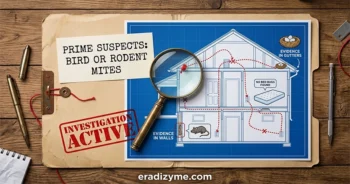
Mystery Infestation: Are Active Animal Nests Causing Your Bites and Crawling Sensations?
How to gather evidence and prove that hidden bird mites or rodent mites are invading your home Where do bird and


Why do you get mystery bug bites after an exterminator gets rid of mice, and how do you get rid of rodent mites?
As the fall and winter months arrive, a quiet shift happens right outside our doors. Driven by dropping temperatures and biting frost, wild rodents, mice, and rats instinctively seek indoor shelter from the bitter cold. No matter what kind of home you live in, whether nestled in a quiet, rural country setting or bustling in a dense urban neighborhood apartment, you have likely encountered these persistent survivalists at one time or another.
A winter rodent invasion begins subtly for everyone. It applies equally whether you are a homeowner or a renter, and regardless of whether your property is a historic farmhouse, a city apartment, a mobile home, or a multi-million dollar estate. You might not actually see the rodents darting across your living space at first; rather, you hear the unsettling scratching sounds in the walls late at night, or you discover a scattering of mouse droppings behind kitchen cabinets, deep pantry alcoves, or under the sink.
It is an annual nuisance that, unfortunately, many people have simply gotten used to dealing with every winter. And if you are thinking, “I have a cat that keeps the rodents out, so I am safe,” later in this article we will discuss the reality of that suspected deterrent.
When people discover a rodent infestation, their minds immediately jump to well-documented health hazards like salmonella, leptospirosis, or hantavirus transmitted through droppings and nesting materials. Pathogens like the Sin Nombre hantavirus carry severe respiratory risks, though wild deer mice (Peromyscus maniculatus) remain the primary carriers of the virus, rather than, the typical house mice or urban rats found in residential neighborhoods.
While these stationary viral risks stay locked inside physical droppings, rodent parasites actively migrate by tracking mammal body heat and carbon dioxide emissions to feed on the blood of the rodents.
This brings us to another threat that most people are completely unaware of, and one of the most difficult to deal with, which is the primary point and focus of this article: rodent mites that successfully make their way into your home. It is a dangerous misconception to assume you are safe just because you have bypassed this issue in the past. In fact, someone can experience a seasonal rodent invasion every single year with absolutely no incident, until the specific time that they do.
When that moment arrives and rodent mites breach your living spaces, the clock is ticking, and how fast you move through your learning curve will make all the difference. Sadly, this is something that most often will have to be your responsibility, to quickly educate yourself and accept the fact that simply hiring a professional may not be the solution.
It is absolutely critical that you act fast to stop a massive environmental population spike before it gets out of control.
The main intent of this article is to explain that these mites, which are documented to feed primarily on animals, are highly capable of transitioning to feed on human blood. To protect your family, you must shatter the dangerous myth that animal parasites only bite animals. While academic literature often focuses purely on their primary hosts, real-world case histories reveal a relentless pursuit of a new blood supply.
As the Eradizyme head researcher, I have looked closely at the real-world experiences of countless individuals over the years, and the data shows that the moment an exterminator removes or poisons the primary rodent host population, thousands of hungry mites face immediate starvation and instinctively shift their targets to humans and domestic pets.
This behavior results in sudden, unexplained skin crawling sensations, mystery bites, and intense rashes that can appear within 24 to 48 hours after the rodent population drops. For a complete breakdown of identifying these physical signs across different populations, refer to our diagnostic reference article, Mites That Affect People.
When these symptoms manifest, it is common for a single isolated individual in the home to bear the brunt of the attacks, a phenomenon we analyze deeply in our web article, The Mite Magnet Mystery: Why They Bite You and Not Your Partner. My real-world research helping sufferers navigate these crises shows that these infestations do not just quickly fade away when the animals are gone. Countless individuals have experienced rodent mite infestations that continue to plague their homes for months after the mice were completely cleared.
In severe scenarios, sufferers have even relocated and moved to entirely new homes, only to discover that these resilient parasites hitchhiked with them, continuing to cause physical biting and skin crawling sensations long after the original animal hosts were left behind. For a deeper look at long-distance parasite transport dynamics, see How Did I Get Bird Mites in My House and What to Do About It.
Rodent mites use electrical wiring and utility conduits in walls to migrate between rooms, bypassing switch plates to target humans when infestations go unmanaged. Ironically, standard extermination triggers the worst of it. When mice and rats are killed or driven out, tiny biting mites, such as the house mouse mite (Liponyssoides sanguineus) and tropical rat mite (Ornithonyssus bacoti), lose their hosts. Attracted by body heat and carbon dioxide, these hungry arachnids flood out of the walls into living spaces.
Chemical and Trap Limitations: Poison rodenticides cause rodents to die in inaccessible wall cavities, prompting thousands of displaced mites to flood into rooms. Similarly, chemical repellents and glue traps often worsen the spread by panicking the rodents and allowing mites to easily cross over or abandon the area. Detailed insights on these trap limitations are available in the article The Threat Exterminators Leave Behind: Rodent Mites.
The Pet Misconception: Owning a cat creates a false sense of security regarding pests. While cats deter mice from main living areas, rodents simply adapt by nesting out of reach in attics, garages, crawl spaces, and basements where major infestations can go entirely unnoticed. Pets do not stop blood-feeding mites; when rodent populations shift or decline, mites migrate from these structural hideaways, using pets as hosts and bringing infestations directly into beds and living spaces.
Extraction & Cleanup: Safe disposal requires heavy-duty double-bagging without compression to prevent aerosolized particles. For residual mites and eggs, plant-based enzymes like proteases, and lipases in Eradizyme Ultra Concentrated Formula dissolve exoskeletons safely without harming people or pets.
Should you be unlucky and a victim of these relentless arachnids invading your living space, we are here to help and coach you through the remediation process. We take this issue very seriously, and so should you, time in this matter is not on your side.
For professional support with persistent infestations or unexplained bites, call our Free Expert Consultation Line at (888) 774–4046 (9:00 AM to 11:00 PM EST) for a comprehensive, zero-obligation evaluation and customized non-toxic protocols.
About the Author: This article was compiled and written by the Head Researcher at Eradizyme.com. It draws from years of deep remote structural troubleshooting, case history analysis, and firsthand experience gained from talking to and coaching a countless number of customers over the phone to navigate an infestation using enzyme-based solutions for domestic parasites.
Medical Disclaimer: The information provided in this article is for educational and structural pest investigation purposes only. It is not intended to be a substitute for professional medical advice, diagnosis, or treatment. Always seek the advice of your physician or other qualified health provider with any questions you may have regarding a medical condition.
Share this article:


How to gather evidence and prove that hidden bird mites or rodent mites are invading your home Where do bird and

How Coconut Oil Fatty Acids Provide Topical Support During Home Eradication How does coconut oil protect skin from bird and
Navigate
Articles
Contact
© Copyright 2005 – 2026 BeyondBeds.com, All Rights Reserved. | Terms and conditions | Privacy Policy