The Hidden Winter Pest Danger: Why Rodent Mites Invade Your Home After Rodent Extermination
When Mice and Rats Die, the Real Nightmare Begins: The Untold Truth About Post-Extermination Rodent Mites Why do you get mystery

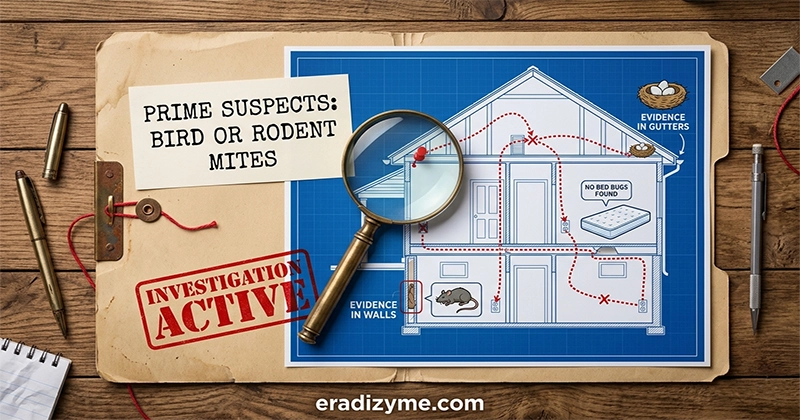
Where do bird and rodent mites hide inside a house structure?
Active bird and rodent mite infestations primarily cluster within hidden structural voids near abandoned nests, such as attic insulation layers, roof eaves, bathroom exhaust vents, chimney caps, and wall cavities. Finding and removing these nesting sources is critical to stopping an indoor mite infestation.
When you are suffering from phantom crawling sensations and mysterious bites, finding the true culprit can feel like an impossible task. Most people spend weeks cycling through dermatological creams, checking their beds for bed bugs, or even calling out professional exterminators who find absolutely nothing. You might find yourself visiting doctors who see nothing on your skin, or even going through a skin biopsy that comes back with a negative result for parasites. Some doctors might even dismiss your symptoms entirely, claiming that the issue is all in your head and that there is nothing physical there.
In many situations, you cannot afford to guess. You need to treat your mystery situation like an active investigation case, where you are the lead detective responsible for tracking down an unseen suspect, and weighing the evidence. Because the unseen suspects are so difficult to spot, nobody is going to hand you the answer. It is up to you to put on your detective hat, systematically document your clues, and build an undeniable case past the guesswork.
Every successful investigation requires a methodical approach. By logging your timeline, tracking your symptoms, and mapping your home’s architectural vulnerabilities, you can identify the true source of your discomfort. If you have an active source of birds nesting in your gutters or under your roof ledges, or wild rodents living in a garage or attic space, that is your primary target, the lead clue that may help you crack your case wide open.

Here is how to gather your evidence, weigh your leads, and identify the true source of your symptoms.
A good detective always starts with the loudest clues. Before trying to track the unseen suspect causing the bites, you must confirm if their hosts are actively living inside your structure.
The Nighttime Scratching: Listen closely to your walls and ceilings during the quiet hours of the night, placing a standard stethoscope or the open end of a clean drinking glass flat against the drywall to help amplify and isolatemuffled scurrying, scratching, or chewing sounds that point directly to prime suspects living inside your structural voids.
The Morning Chirping: Pay close attention to your home exterior at dawn, since persistent chirping, tweeting, or shuffling noises indicate that birds are actively nesting under roof ledges, inside gutters, or within window air conditioning units and structural vents.
The Host Entry Points: Walk around the exterior of your property with a high-intensity LED tactical flashlight to log any structural gaps in the roofline, damaged attic vents, torn soffit screens, or unsealed openings around gutters and roof ledges where birds can nest. For rodents, inspect low-level areas for slab edge gaps, unsealed basement window seams, or small holes near the foundation. Locating these exterior breaches allows you to trace exactly where wild animals are entering the structure to establish their nests.
Once you have noted the active nest as your primary suspect, the next step in your investigation is mapping out the transit routes. You need to understand exactly how these culprits cross the boundary from the wild animal’s nesting area into your personal living space. The invaders exploit specific structural vulnerabilities to travel through your home.
The Shared Airspace: A structural airspace infiltration occurs when parasite-ridden host nests are physically constructed inside your HVAC ventilation returns. The regular cycling of your heating and air conditioning units creates airflow that pulls loose, unseen invaders out of the vents and directly into your shared living space.
The Electrical Wiring: Rodents and birds frequently nest near internal wiring. These unseen invaders utilize the electrical lines as a physical highway system, traveling behind your drywall until they reach the gaps around outlet boxes and light switches right next to your bed. To help map these specific structural pathways in your home, you can use the drinking glass method against the drywall to isolate the scratching sounds of the nesting hosts, or review our full guide on THE HIDDEN HIGHWAY: TRACKING DOWN THE INVISIBLE NESTING SITES THAT PROFESSIONAL EXTERMINATORS MISS.
The Ceiling Gaps: Nests located in the attic sit directly above your ceiling fixtures. Recessed lighting, hard-wired smoke detectors, and ceiling fan mounts all require holes in the drywall, providing a direct downward drop point for the hidden culprits looking to expand outward from an overcrowded nest.
The Wall Seams: As the population in a wall void or crawlspace peaks, the intruders migrate along the baseboards, flooring seams, and window casings. They utilize the tiny architectural expansions and contractions of the house to slip into bedrooms undetected.
Your own body provides critical forensic evidence that can help you eliminate other common household Invaders from your suspect list.
The Crawling Sensation: Note exactly when you feel movement on your skin, especially if you feel a distinct tickling or prickling sensation that is highly active at night but leaves nothing to see.
The Bite Patterns: Track where the skin discomfort occurs and note the physical size of the bumps. Traditional household pests like bed bugs typically leave larger, swollen, puffy welts that frequently form in organized straight lines or clusters of three. If you notice that your bumps are vastly different, presenting instead as tiny, scattered red pinpricks or intense, widespread rash-like dots, note this down as a massive clue. These tiny pinpricks suggest you are dealing with a completely different type of unseen intruder that requires a different tactical investigation.
Ruling out Bed Bugs as a Suspect: The most common household pest associated with nocturnal biting, the traditional bed bug, is naturally your primary suspect when tracking down mysterious skin irritation. To inspect for them, conduct a thorough examination of your mattress seams and headboard. Scan with a high-intensity LED tactical flashlight while running the edge of a standard plastic credit card along the piping to peel back and scrape out hidden areas, looking closely for blood streaks or tiny black ink spots in the fabric seams, as these are classic bed bug signs.
If your bites resemble mosquito bites and become itchy several hours after you wake up, pay close attention, as this delayed flare-up is a hallmark sign of a bed bug’s numbing saliva. However, if you are experiencing this distinct symptom pattern but your thorough physical flashlight and credit card inspection reveals an absolutely spotless mattress with zero fecal dots or blood stains, this primary suspect officially becomes a cold lead.
When your skin is reacting to a nocturnal, blood-feeding threat but your bed is completely clear of physical evidence, the investigation shifts focus away from these traditional household pests and points toward an infiltration expanding out from nearby architectural voids.
To learn more about identifying these specific feeding signs, you can review the Eradizyme Bed Bug Guide.
A good detective does not just collect clues, they weigh them against each other to build an airtight case. When you are dealing with an active bird or rodent source, you must look at the balance of probabilities to confirm your diagnosis.
Look at your written notes and weigh your evidence using these three criteria:
The Timeline Sync: Compare the overall timeline of your skin irritation with the presence of the hosts. Look for a matching pattern over days or weeks, noting if your crawling sensations and bites began or intensified during the same season that birds established nests on your exterior, or right as you noticed a sudden influx of rodent activity in your structure.
The Location Proximity: Map where the bites happen against where the animals live. If the sensation occurs primarily in a bedroom that sits directly beneath a bird nest under the roof ledge, or next to a wall with active rodent activity, the proximity weighs heavily in favor of a bird or rodent mite spillover.
The Elimination Factor: Weigh the absence of other culprits. If you have thoroughly inspected your bedding, found zero traces of bed bugs or fleas, and topical skin treatments from your doctor have failed to provide relief, the evidence shifts decisively toward wildlife parasites.
When you weigh all three factors together, active wildlife sounds, proximity to entry pathways, and the total absence of traditional bed bugs you have officially found your SMOKING GUN, and discovered that bird or rodent mites are the true culprits. You have successfully cracked the case, and as you move from the investigation phase to targeted remediation, remember that you are not alone.
We at Eradizyme.com are always available by phone at (888) 774 4046 from 9:00 AM to 11:00 PM EST, seven days a week, to provide direct personal coaching and help you map out your next tactical steps through this exhausting process.
Because avian and rodent parasites are incredibly elusive and translucent before feeding, clinical detection is a massive hurdle. Medical case studies indexed on PubMed demonstrate that skin biopsies often come back completely negative because, according to the experts, bird or rodent mites do not live or burrow in human skin; they merely bite and retreat back to their structural highways.
According to documentation tracked by the Center for Disease Control and Prevention (CDC), these parasitic arachnids routinely use wild rodents and birds as vehicles to move into human environments. When local doctors or exterminators cannot find physical proof, it is not because it is in your head, it is simply because traditional methods are operating on old, outdated data and lacking the specialized experience it takes to solve this specific case, meaning they are looking in the wrong place entirely.
Cracking your case is only half the battle. Once you have pinpointed the active nest and mapped out the transit routes, the investigation is officially closed and your tactical counteroffensive begins. As discussed in other articles, on eradizyme.com under the Eradizyme Knowledge Hub Section of the website you must now shift your mindset and treat this situation like you are at war with an unseen invader.
A successful campaign requires cutting off logistical supply lines before the enemy can advance further into your territory. In this conflict, those supply lines consist of the exact architectural pathways you uncovered during your investigation:
By understanding exactly how these intruders move, you can deploy your liquid enzyme barriers tactically, securing your perimeters and protecting your sleeping zones while you prepare to neutralize the primary source.
Now that you have determined you are battling a physical mite infestation, it is time to start your spray protocol with our Eradizyme ultra-concentrated formula. This all-natural, non-toxic formula allows you to mount a powerful defense right along those critical structural highways and hiding places.
You should concentrate your efforts on the areas where you spend the most time, thoroughly spraying under mattresses and box springs, along bed rails, behind headboards, around bed frames, and along baseboards where these hidden marauders congregate. Make sure to also treat the structural crevices of high-use living room furniture, including underneath and around the fabric seams of sofas, recliner chairs, and cushions, without introducing harsh chemicals into your environment.
By taking immediate control of your perimeters with the correct application, you can neutralize the crawling threat and turn the tide of the war. To get started on your home remediation plan, you can Learn More About our Eradizyme Multi Purpose Enzyme Cleaner and Eradicator to secure your household boundaries today.


When Mice and Rats Die, the Real Nightmare Begins: The Untold Truth About Post-Extermination Rodent Mites Why do you get mystery

How Coconut Oil Fatty Acids Provide Topical Support During Home Eradication How does coconut oil protect skin from bird and