
The Hidden Winter Pest Danger: Why Rodent Mites Invade Your Home After Rodent Extermination
When Mice and Rats Die, the Real Nightmare Begins: The Untold Truth About Post-Extermination Rodent Mites Why do you get mystery


James and his wife Jill are lying in bed one morning when a faint chirping sound echoes from just outside their bedroom window. Looking closer, they discover a newly built bird’s nest outside on the windowsill. They smile at each other, finding the bird’s nest innocent enough and highly interesting to watch, merely a harmless sign of nature settling in for the season. Within a week, an army of pepper-flake-sized bird mites breaches the window casing, migrating down the wall and along the baseboards toward the bedposts. Jill wakes up with clusters of intensely itchy, tiny red welts, completely unaware that an El Niño climate cycle miles away has directly orchestrated this domestic invasion. This scenario is playing out with increasing frequency across the globe as shifting atmospheric conditions break down the natural boundaries between wildlife pests and human living spaces.
For those who have never encountered the term, El Niño refers to a massive, naturally recurring climate pattern originating in the tropical Pacific Ocean. It occurs when the standard trade winds that blow from east to west weaken, causing a colossal reservoir of unusually warm ocean water to surge eastward toward South America. This dramatic ocean warming releases an immense volume of stored heat directly into the sky. The resulting atmospheric shift radically alters weather systems worldwide, dumping torrential rains across some continents while triggering intense heatwaves and humidity spikes in others.
The current calendar year is breaking historical records because this emerging El Niño is clashing with an already elevated baseline of global atmospheric temperatures. Climate monitors at the World Meteorological Organization (WMO) have issued urgent warnings indicating that the tropical Pacific has warmed with alarming speed, threatening a potentially historic “Super El Niño”.
Aggregating this data, NOAA’s long-range seasonal summer forecasts are already anticipating above-average heat dominating the Western U.S. and much of the lower 48 states. In modern history, human societies have never experienced an intense El Niño event superimposed on top of baseline global temperatures that are already hot. This environmental collision is effectively pouring rocket fuel on global heat indexes and atmospheric moisture levels.
This unprecedented combination of climate factors directly alters the pest landscape inside suburban and urban neighborhoods. Mainstream pest advice often claims that cold weather is the main driver that pushes wildlife indoors for shelter. This perspective completely loses the point because winter entry is merely a symptom of a much larger crisis: the warm, humid weather of an El Niño spring and summer acts as a massive biological incubator. The current extreme climate conditions do not simply force pests to relocate; they exponentially multiply the baseline population of parasites long before the weather ever cools down.

Mainstream pest control discussions frequently treat bug outbreaks as isolated, seasonal annoyances caused by poor housekeeping or bad luck. This narrative is dangerously inaccurate because it ignores macro-level climate data. The global climate system is experiencing prolonged El Niño phases and steady temperature increases that act as massive environmental accelerators for ectoparasites. When regional weather grows warmer and holds more moisture, the baseline biological timeline for these tiny pests undergoes a radical transformation.
Bird mites, scientifically classified as ( Dermanyssus gallinae ) and Ornithonyssus sylviarum, alongside rodent mites, known as( Liponyssoides sanguineus ), are highly sensitive to thermal and atmospheric fluctuations. Under historical climate norms, cold winters naturally culled host populations and forced remaining mites into prolonged periods of dormancy. Modern climate trends have largely eliminated these natural environmental brakes, allowing overlapping generations of pests to survive throughout the calendar year without interruption.
The acceleration of the mite life cycle under warm, humid conditions is a matter of pure mathematical compounding. In standard conditions, it takes up to three weeks for a mite egg to transition into a fully reproductive adult. Controlled data published in the Journal of Medical Entomology demonstrates that when ambient temperatures rise and humidity levels cross a 70% baseline, the entire developmental timeline from egg to reproducing adult compresses to less than a week.
Because this rapid turnaround allows multiple generations of offspring to mature and begin breeding simultaneously, a single fertile female mite can spawn an overlapping lineage of thousands of descendants in less than a month, triggering an exponential population explosion that catches property owners completely off guard
A common misconception among homeowners is that heavy rains and flooding drown out pest populations. Global ecological tracking data reveals that the exact opposite occurs during strong El Niño cycles. Increased rainfall in arid and temperate zones triggers a rapid ecological reaction known as a trophic cascade. The sudden abundance of moisture causes an immediate overproduction of environmental vegetation, wild seeds, and ground cover, which introduces an artificial surplus of food into local ecosystems.
This sudden abundance of food resources removes the primary natural constraint on wild host populations. Rodents and wild birds enter rapid, continuous breeding cycles, producing multiple litters and clutches back-to-back. Property lines, attics, and crawlspaces quickly fill up with dense populations of mice, rats, pigeons, and starlings. Because these animals serve as the primary blood hosts for parasitic mites, an explosion in the host reservoir automatically translates into an explosion in the parasite population.
Crucially, this sudden seasonal spike in urban wildlife is severely compounded by a much larger, long-term environmental crisis. While weather cycles provide the immediate catalyst for rapid breeding, the widespread overuse of chemical pesticides has decimated natural insectivores like birds and bats.
This predatory vacuum allows resilient urban adapters like rodents and starlings to multiply completely unchecked. Furthermore, pesticide exposure leaves remaining wildlife populations with severely degraded internal immune systems. These vulnerable animals transform into ideal, defenseless hosts, sustaining massive parasite colonies that eventually overflow into our residential spaces.
The danger to humans peaks when these temporary environmental resources inevitably dry up, or when sudden heatwaves hit the area. When a rodent population crashes due to a sudden lack of food, or when a clutch of wild birds abandons a warm nest under a roof eave, millions of hungry mites are instantly left without a primary host. Driven by pure survival instinct, these microscopic arachnids abandon the dead or empty nests and stream through electrical outlets, window frames, and wall voids in search of alternative blood meals.
While environmental factors dictate the absolute volume of pests in a geographic region, individual susceptibility determines who bears the brunt of an indoor invasion. System vulnerability data published by the Eradizyme research team outlines how a compromised internal defense system serves as the primary driver that transforms an individual into a literal chronic Mite Magnet™. This framework explains why certain residents within the exact same household can be relentlessly targeted by migrating parasites while others remain completely untouched.
When a human body experiences chronic stress, systemic inflammation, or lack of sleep, its immune response drops significantly. This internal crash alters the host’s skin chemistry, surface body heat, and the specific volatile organic compounds emitted through sweat. Parasitic mites rely entirely on specialized thermal and chemical receptors to locate blood sources. A healthy body maintains robust cellular defense mechanisms that emit natural deterrent signals, whereas a vulnerable, run-down biological system transmits, an open chemical invitation to seeking pests.
Once a person transitions into a chronic Mite Magnet™ state, they become trapped in a persistent attraction cycle that is incredibly difficult to break using superficial pest controls alone. The mites detect the compromised host’s distinct chemical signature from a distance, ignoring alternative targets to focus their feeding efforts on the most vulnerable organism available. Resolving this nightmare requires a dual approach: you must aggressively clean your physical environment while proactively supporting your internal biological health to shut down the chemical signals that attract these organisms.
Waiting until you see a bug or feel a crawl on your skin before taking action is a recipe for a catastrophic residential infestation. Because bird and rodent mites are nearly transparent and measure less than a millimeter in size, they are practically invisible to the naked eye until thousands of them gather in one spot. You must maintain a state of hyper-awareness, treating the protection of your home as an ongoing, proactive structural defense, rather than a reactionary cleanup job.
Proactive auditing means regularly inspecting the exterior perimeter of your home for any signs of wildlife activity long before the weather reaches peak humidity. Look for avian nesting materials tucked inside dryer vents, behind outdoor light fixtures, or beneath porch roofs. Check crawlspaces and basement foundations for fresh rodent droppings, rub marks or sebum trails along baseboards, or shredded insulation materials. If you spot even a single abandoned nest or a minor rodent entry point, you must assume that thousands of mites are already waiting behind the drywall, ready to migrate the moment the ambient temperature spikes.
Speed is the ultimate deciding factor when dealing with climate-driven ectoparasites. A minor, localized cluster of mites can be completely eliminated if caught within the first forty-eight hours of host abandonment. If you delay action by even a few days, the pests will scatter deep into the flooring, behind structural framing, and up inside sofas and recliner chairs, turning a simple remediation into an expensive, multimonth battle. You must train yourself to notice the earliest warning signs, such as unexplained pinprick biting sensations at night or tiny, moving specks on your smartphone screen, and deploy aggressive counter-measures immediately.
When an infestation breaches the interior living space, you must abandon passive treatments and execute a systematic environmental cleanup. Bird and rodent mites cannot survive indefinitely without a host, but they can endure weeks, and in our own field research with customers, months of starvation if the indoor atmosphere mimics their preferred outdoor climate.
While official data may contradict this timeline by claiming these parasites only survive for days or weeks, our real-world case analysis demonstrates an entirely different level of environmental resilience. Field metrics evaluated in global urban vector data compiled by the World Health Organization (WHO) highlight that aggressive, total atmospheric manipulation is required to break the survival thresholds of indoor populations.
Allowing your indoor spaces to remain warm and humid during an active climate anomaly like El Niño provides these mites with the optimal conditions they need to multiply out of control. By taking immediate control of your home’s internal temperature, reducing environmental moisture, and sealing every physical vulnerability on the buildings exterior, you break the cycle of infestation. True protection requires total vigilance, rapid action, and a refusal to tolerate even the smallest sign of wildlife pests near your home.
As discussed across these articles on this website Eradizyme.com, mastering a chronic indoor parasite infestation comes with a steep biological learning curve. Our goal at Eradizyme is to help speed you through that learning curve as quickly as possible, saving you from months of wasted trial and error. This is absolutely not a situation where you can afford to be lazy, complacent, or hope for an effortless surface fix. Leaving hidden internal reservoirs unaddressed could cost you dearly in financial loss, property damage, and severe emotional exhaustion.
Our advice and knowledge are based on the countless numbers of people we have assisted over the years. Through rigorous questioning and real-world case analysis, we have determined the most likely bird and rodent mite hiding places in most homes, and many of these structural sanctuaries are areas you would never suspect.
If you are exhausted from dealing with unexplained skin crawling sensations, mystery bites, and cannot figure out how these persistent mites are still entering your living spaces, you do not have to map your home’s infrastructure alone. You can consult with our resident expert directly at (888) 774–4046 from 9:00 AM to 11:00 PM EST for a comprehensive, zero-obligation evaluation.
We will help you look beyond the superficial surfaces of your rooms, help you track down the specific architectural pathways unique to your home’s layout, and customize a non-toxic molecular protocol engineered to clear the internal places where mites may be hiding. To uncover more hidden biological data on bypassing broken inspection guidelines, continue reading through the educational articles on the Eradizyme Knowledge Hub and the various informational pages throughout this website.
World Meteorological Organization (WMO): Update on Global Climate System Tracking, Climate Center Core Assessment. WMO Official Statement on El Niño Anomalies
Journal of Medical Entomology: Volume 36, Issue 1. Thermal and Atmospheric Influence on Ectoparasitic Reproduction Rates. Oxford Academic Database
World Health Organization (WHO): Public Health and Environmental Health Frameworks. Guidelines on Urban Insect and Ectoparasite Vector Containment. WHO Urban Pest Evaluation Repository
Eradizyme Technical Protocols: Internal Data Structure Guide. Enzymatic Cleaning Protocols for Chitin Matrix Dissolution. Eradizyme Cleaning & Laundry Documentation Pages


When Mice and Rats Die, the Real Nightmare Begins: The Untold Truth About Post-Extermination Rodent Mites Why do you get mystery
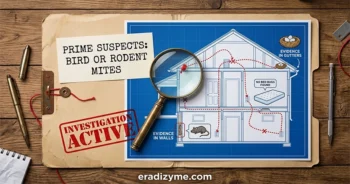
How to gather evidence and prove that hidden bird mites or rodent mites are invading your home Where do bird and