
The Hidden Winter Pest Danger: Why Rodent Mites Invade Your Home After Rodent Extermination
When Mice and Rats Die, the Real Nightmare Begins: The Untold Truth About Post-Extermination Rodent Mites Why do you get mystery

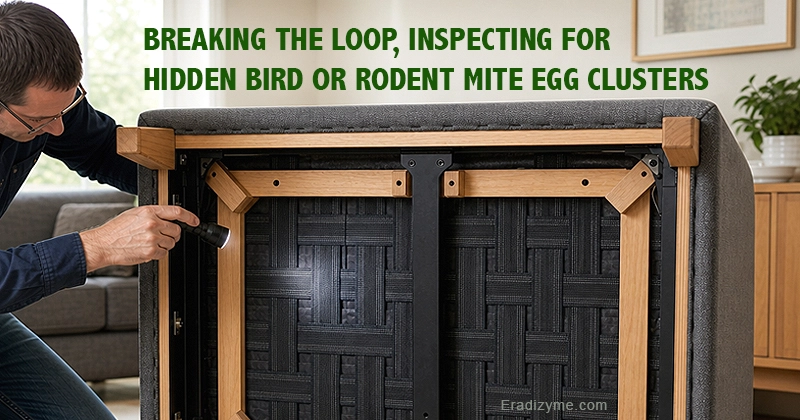
Where do bird and rodent mites hide their egg clusters inside furniture?
Bird and rodent mites systematically anchor their sticky egg clusters inside hidden furniture microhabitats, including wooden joints, mattress piping, upholstery staples under seating frames, and electrical housing transitions. These hidden clusters form a rolling daily production line that multiplies rapidly under standard indoor temperatures.
Let us clear up the absolute confusion and massive internet misunderstandings surrounding bird and rodent mite life cycles. I get a lot of disjointed questions about this, and often when a customer calls our consulting specialist line, they usually start with an anxious, “I read on the internet that…” type of “is this true?” question. The harsh reality is that almost all online pest data completely fails to discuss the deeper evolutionary mechanics we are uncovering here, which leaves thousands of home sufferers misinformed, exhausted, and stuck in a losing battle. My goal with this article is to completely cut through the generic, superficial science, connect the hidden biological dots directly, and tell it to you straight in plain English so you can permanently break the cycle of confusion.
Bird and rodent mites possess an explosive, multi-tiered reproductive cycle that allows their hidden populations to multiply into the thousands every seven to ten days. Sufferers often fail to realize that these life cycles are completely unsynchronized and overlapping, meaning this parasite factory does not explode all at once on a single day, but instead functions as a non-stop, rolling production line that hatches and multiplies every single day.
When these sub-millimeter bird mites or rodent mites lose their primary natural hosts due to the abandonment or presence of active wild nests, or following the removal of active rodent infestations during attic extractions, they migrate directly down through unsealed wall cavities to occupy your immediate living environment. Once inside your private space, a female bird mite (Dermanyssus gallinae) or rodent mite (Liponyssoides sanguineus) transforms your furniture, bed frames, and mattress seams into an active breeding ground.
Understanding the chemical blueprint and physical geometry of how these specific mites secure their eggs is essential to dismantling their structural perimeter. To understand this hidden environmental handoff, click the link to review The Threat Exterminators Leave Behind regarding Rodent Mites to see how seamlessly these populations shift targets directly into human living spaces.

Bird and rodent mites do not deposit their eggs blindly, nor do they scatter them loose across flat fabric surfaces. Instead, the female utilizes a highly advanced, chemical anchoring mechanism designed by evolution to maximize egg survival off the host.
The speed at which bird and rodent mites multiply is driven by an unyielding biological formula where population acceleration is directly tied to the availability of a blood surrogate.
As established in our critical research on host tracking radars, click the link to review The Invisible Beacon and Skin Heat Signatures to see how their anatomical framework relies on highly specialized chemosensory mechanisms to seek out human hosts the second they emerge from these hidden furniture egg clusters.
When bird and rodent mites enter your furniture, they do not remain out in the open on exposed seat cushions or bare mattress top surfaces. Their tarsal sensilla receptors guide them away from light and open air, leading them deep into the micro-conduits, structural joints, and hidden voids of your interior décor.
Note: If you are currently experiencing ongoing movement or sensory disruption directly on your skin following spray applications and do not see any visible mites, click the link to read Still Crawling and Biting After Spraying Mites to separate real structural survivors from ongoing cellular nerve trauma.
Based on the many consulting calls we receive, this is what our customers are saying, as we are not assuming this based on guesswork when we state that attempting to eliminate these multi-layered communal clusters with name-brand retail neurotoxin sprays is an absolute failure loop. These toxic sprays fail completely because surface chemicals cannot penetrate the protein-polysaccharide adhesive matrix or the hardened chitin shell of the egg clusters. Worse, the chemical spray vapors trigger their tracking radars, causing adult survivors to retreat even deeper into your wall framing and furniture joints.
To win a tactical war against an exponential population explosion, you must deploy an uncompromising biological counter-strategy. To learn how to systematically fortify your body’s defensive barrier from the inside out against this ongoing daily hatching loop, click the link to review The Importance of Building Your Immunity against Parasitic Intrusions to discover how to build a strong immunity. Externally, by applying Eradizyme Ultra Concentrate, and by applying we mean spraying all areas discussed in this article and other pages throughout this website on a daily basis to break the life cycles of the rapidly multiplying invaders, you completely bypass their chemical resistances.
The specialized, plant-derived multi-enzyme solution initiates enzymatic hydrolysis directly on contact. It targets the specialized beta-glycosidic bonds of the protective chitin shell and dissolves the sticky protein-polysaccharide matrix coating the egg clusters. This molecular action breaks apart the cluster geometry, permanently dissolving both the active adult bird and rodent mites and their hidden egg pockets at the physical source before they can hatch into blood-seeking nymphs.
Succeeding against a bird and rodent mite infestation means abandoning superficial thinking and respecting the raw biological programming of your opponent. When you understand that these parasites operate as an unsynchronized, non-stop daily manufacturing line anchored by an industrial-strength protein-polysaccharide glue, you stop wasting emotional energy and financial resources on ineffective consumer sprays.
You do not win this battle by chasing individual crawling anomalies across a cushion. You win by launching an aggressive, molecular counter-strike that targets the hidden substrate coordinates of the egg factory itself, permanently dissolving their reproductive geometry and reclaiming the sovereignty of your home.
About the Author: As the head researcher at Eradizyme.com, I have spent over a decade gathering real-world field insights by directly speaking with and coaching hundreds of families through active bird and rodent mite infestations. Through intensive consulting calls and rigorous questioning, I uncover exactly where people are being bitten, identify hidden nesting locations inside properties, and apply practical, bio-enzymatic protocols to break the rolling daily breeding cycle.
For an honest, zero-obligation, one-on-one assessment of your unique situation, call our resident specialist directly at (888) 774–4046 from 9:00 AM to 11:00 PM EST.


When Mice and Rats Die, the Real Nightmare Begins: The Untold Truth About Post-Extermination Rodent Mites Why do you get mystery
How to gather evidence and prove that hidden bird mites or rodent mites are invading your home Where do bird and